
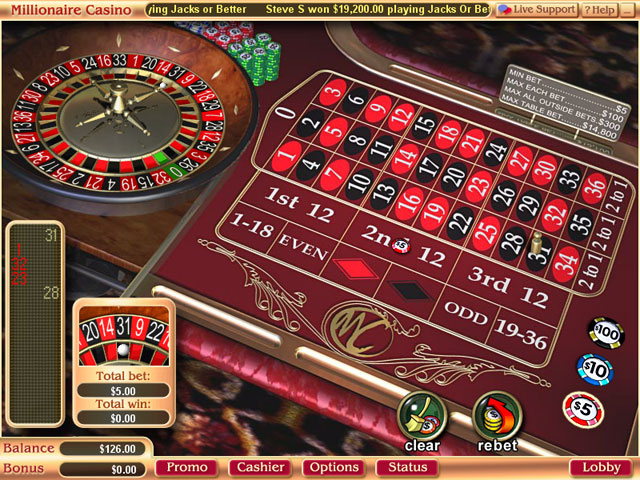
 Roulette is one of the most popular casino table games around, whether referring to the American or European version. One major difference between the two is American wheels have 36 numbers, plus a 0 and 00, for a total of 38 possible outcomes.
Its numbers are placed at opposite ends of the wheels, with 1 being opposite of 2, 3 being opposite of 4, etc. and will usually receive about 100 spins an hour. European wheels have 36 numbers and only one 0, for a total of 37 possible outcomes. Its numbers are placed in no particular order and will usually receive about 30 spins per hour. While these differences may seem subtle, they affect the odds greatly.
Roulette Rules
The Croupier is the dealer in charge of the Roulette table who spins wheels in one direction, then launches balls the other way. The ball spins around the edge of the wheel until it slows down and eventually lands in a numbered box. No bets can be placed after the ball has made two full revolutions around the wheel.
Once the ball has landed in a numbered square the Croupier will announce the winning number, as well as its color. They then collect all losing bets and pay out all winning ones. Once the board is clear a new round begins with the process starting over again.
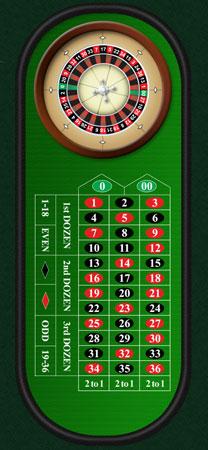
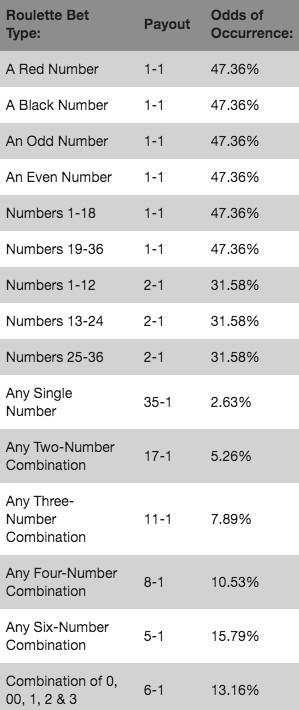
Many casinos offer both American and European wheels, with the House advantage on a single number stake in American being 5.26% (2 out of 38), as opposed to half that (2.70% or 1/37 in European). Despite this fact, the American version remains wildly popular as it offers a clean layout and a much more organized arrangement of betting boxes than its European counterpart. Refer to the chart below for a listing of odds and payouts of every possible outcome at an American table.
It’s the European version which offers the best odds due to it having one Zero while the American wheel has Zero and Double Zero sections. This small change drastically affects the odds in the long run. In addition, some European tables also offer extra player-friends rules such as the ones below.
In Prison Roulette Rule
If the ball lands on Zero the Croupier will not clear losing stakes of red/black, even/odd, and 1st half/last half, and they instead stay on the table “in prison”. On the next spin, players who win with these chips will be paid out at no additional expense.
Should the wheel land on Zero once again, wagers will still carry over until the next spin having a colored number called: this essentially nullifies the chances of losing on a Zero. This truly fantastic rule diminishes the House advantage to a mere 1.35%, making it a highly sought after variant.
La Partage Roulette Rule
La Partage is French for “the divide”, with the rule applying much in the same way as “In Prison” does, with the difference being that a Zero results in players receiving half their stake amount back. This rule diminishes the House advantage to 1.35%.
The Roulette Strategy Marathon
Roulette strategies have floated around for years but way back in 1971, Englishman Patrick O’Neil-Dunne tested a multitude of theories during a marathon session consisting of 20,000 spins at table #14 at the Macao Casino. Spanning a full month between April and May of that year he tested every alleged system, including one he devised himself.
 No strategic system tested gave any return on investment. He initially believed that a strategy composed of bets on one column (12 numbers) would prove effective, but it too eventually failed. His theory was to stake a column that had not been hit for 6 or more spins in a row, then wagering on that column using the Martingale betting system, first 1-2-4-8-16-34 through six spins. If he had not emerged victorious after six spins, he would drop the sequence and begin again. The reasoning behind this was mainly the cost of the Martingale progression system because it would simply become too expensive to continue playing without winning any funds back.
During the course of his 20,000 spins only 1 out of 100 did an even money bet lose more than eight times in a row. O’Neil was actually drawn to staking numbers that had not been hit for a long period. He believed once a number was hit, it would soon come again and found success covering numbers fitting this criteria, especially ending ones such as: 6-16-26-36. When these numbers had been quiet for 36 straight spins, he would always cover them with chips.
After 31 days, O’Neil (and his team) wound up with a net profit of $191,148, which doesn’t count what was sure to be a large amount of tip money given to table staff. He placed wagers ranging in size from $1 all the way up to $500 and in the book Roulette for the Millions (Chicago 1971), it documents how O’Neil planned the adventure, as well as conclusions made upon its completion. It’s interesting to note that in spite of his massive winnings, O’Neil still claimed that his success was due in larger part to luck than mathematics.