
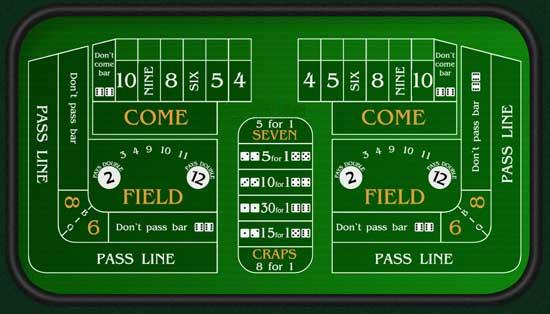
Craps can be intimidating to newbies due to how much action is on the board and how confusing it all seems. The good news is that it’s not hard to learn and there’s even a way to gamble from behind so you never even have to touch the dice.
Be forewarned that at online casinos it’s only you and the software so things move a lot more quickly. Therefore, ensure to keep an eye on balances at all times as funds can disappear quickly if not paying attention.
Craps Rules
A typical craps table has three sections with the middle one being where the boxman and stickman each assume one side. The boxman is responsible for exchanging players’ cash for chips, as well as maintaining a sense of order among those assembled.
The stickman is the one who hands dice to players and places action on the table. The two identical side sections each have a dealer assigned to them, with players occupying the sides opposite the croupiers who take care of everything: exchanging chips, paying out winnings, collecting losses, and assisting with wager placements.
Those gathered around wait in turn (clockwise) for their time to throw the dice. The stickman offers a player several dice from which they will select two that “feel” best. This person is known as “the shooter” and they determine the fate of everyone who has placed money down on the action. There is no limit to the number of players able to wager during the round.
Pass / Don’t Pass
Before making a first throw of the dice, a player must make one of two bets: a Pass or a Don’t Pass. The first toss, called the Come-Out Roll, must be strong enough to hit the opposite wall of the table and will result in either an immediate win or loss, or will commence a new series of rolls, as per the following rules.
A roll of 7 or 11 is known as a Natural and will result in Pass Lines wagers being instantly victorious (paying out at odds of 1-1) or a loss on Don’t Pass ones. The round is finished and a new one will begin with fresh Pass Line stakes and a Come-Out Roll toss.
A roll of 2, 3 or 12 is called a “Craps” and leads to Pass Lines promptly losing and the round ending. A new one then begins featuring a different shooter, with a roll of 2 or 3 triggering an immediate win on Don’t Passes, while a roll of 12 will result in a draw and money is returned.
A result of anything other than ones mentioned above (4, 5, 6, 8, 9, 10) will mean the fate of Pass Lines are determined by the upcoming series of dice tosses. If one was placed the objective is to once again toss the same number as the Come-Out Roll, before seeing a 7. Conversely, Don’t Passes want to see a 7 before hitting the same number as the Come-Out. Even if there isn’t any money on Don’t Pass, Shooter status is lost immediately upon throwing a 7, but if victorious the Shooter continues.
Craps Probabilities
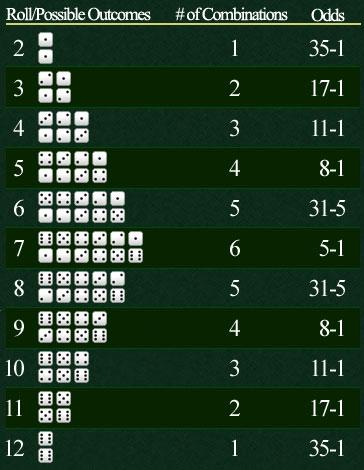 In order to increase the odds of winning it’s important to understand the probability of each possible outcome when rolling two dice. There are a total of 36 different possibilities, with the most frequent being a roll of 7 (1 out of 6 chances). The opposite end of the spectrum are the two least frequent outcomes, which are rolls of 2 and 12 (1 out of 36 chance for each). The probability of winning a Come-Out Roll is calculated by simply adding the odds of rolling a 7 (1 out of 6) with those of rolling an 11 (1 out of 18), and then the math reveals it’ll happen 2 times out of 9.
The odds of rolling a 2 (1 out of 36) + a 3 (1 out of 18) + a 12 (1 out of 36) = 1 out of 9. So in reality, there’s a better chance of winning the Come-Out Roll than losing it. In regards to the odds of winning a Pass Line versus a Don’t Pass, on a first roll the chances of winning a Pass Line are 2 out of 9, as opposed to a Don’t Pass with a 1 out of 9.
However, once a point has been established the chances of rolling it again decrease by 1 out of 36. So for example, on a roll a 4 the odds of rolling another 4 would only be 1 out of 12. Although the chances of nailing a 7 are 1 out of 6, so the odds of rolling a 4 before a 7 are cut in half.
Craps Strategy Guide
There’s no way to beat the House edge long-term but there are ways to increase the odds of winning in the short-term. Craps is maybe the most fun game to play live, offering people the opportunity to potentially win a few bucks while getting excited with groups of strangers. With that in mind, there are several strategies that might help sway the numbers in the players’ favor.
| Point: | Odds Bet Payout: |
|---|---|
| 4, 10 | 2-1 |
| 5, 9 | 3-2 |
| 6, 8 | 6-5 |
Odds Bets
An Odds Bet can be added on to the original Pass or Don’t Pass stake allowing an increase of the initial amount by adding more money to it, provided it has not been won or lost on the Come-Out Roll. The beauty of an Odds Bet is that there is no House edge on it.
For example, if the Shooter has established a point of 5, they will win Pass Lines 4 out of 6 times. What is the math behind this? Well, the odds of rolling a 5 are 4 out of 36, while the odds of a 7 (and thus losing on a Pass Line) are 6/36. So in this case, an Odds Bet on the Pass Line would pay 3-2, while one on Don’t Pass would pay 2-3. Obviously, these are true odds with no House-adjusted edge.
| Odds Bet: | Casino Edge: |
|---|---|
| Pass Line Bet | 1.41% |
| 1x Pass Line Bet | 0.85% |
| 2x Pass Line Bet | 0.61% |
| 5x Pass Line Bet | 0.32% |
| 10x Pass Line Bet | 0.18% |
| 100x Pass Line Bet | 0.02% |
Most establishments permit placing an Odds Bet no bigger than double the size of the original Pass or Don’t Pass amount. Placing one reduces the House’s overall edge to a mere 0.85%, making it one of the best options on the gaming floor.
Come and Don’t Come Bets
These are nearly identical to the Pass and Don’t Pass options, with one exception being you cannot place a Come or Don’t Come during the Come-Out Roll. Just as with a Pass Line, it’s an instant win if a 7 or 11 appears and an immediate loss if a 2, 3 or 12 is realized. If none of these are hit the Come Bet will be moved to the established point. The ensuing rolls act as point rolls and if the point is hit before a 7, Come Bets are won and vice versa. As with Pass or Don’t Pass, it’s also possible to add an extra stake.
| Number: | Casino Odds: | True Odds: | Casino Edge: |
|---|---|---|---|
| 4 | 9-5 | 2-1 | 6.671% |
| 5 | 7-5 | 3-2 | 4.00% |
| 6 | 7-6 | 6-5 | 1.52% |
| 8 | 7-6 | 6-5 | 1.52% |
| 9 | 7-5 | 3-2 | 4.00% |
| 10 | 9-5 | 2-1 | 6.67% |
Place Number Bets
These are bets that can be placed on the numbers 4, 5, 6, 8, 9 or 10, and are only permitted to take place after the Come-Out Roll. This is a very simple option as it will pay out winnings if the player number is rolled before a 7.