
Baccarat is a popular, high-stakes casino game enjoyed worldwide. In spite of the word Baccarat meaning “zero” in Italian, the goal is to get as close as possible to 9, with 0 actually being the worst possible score. Cards are dealt to two hands, aptly named the “Player” and the “Banker”. You can choose to bet on either or a tie, or any combination of the three. People take turns acting as the Player or Banker, but it can also be played “from behind” with action on either hand.
Baccarat Rules
Unlike a blackjack hand, a Baccarat hand cannot go “bust” or over. Aces are worth 1, face cards (Jacks, Queens, and Kings) are worth 10, and all other cards are worth their numerical value. Only the second digit of the total counts toward the final score. For example, someone holding a 7 and a Queen would have a total of 17, however, in Baccarat, this hand’s value is a 7. Another example would be someone holding a 6 and a 5; even though the cards add up to 11, its value would merely be 1.
A round begins with both the Player and the Banker being dealt two cards. If either hand totals 8 or 9, called “natural hands”, action is stopped as it’s a winner. If both hands have 8 or 9, the result is a tie. If neither hand totals 8 or 9, the dealer instructs those seated on next steps according to House rules. As these are enforced by dealers, players don’t necessarily need to know precise details to get in on the action, however, it’s obviously advised to know as much as possible before sitting down.
|
The Player must draw a card if the hand ranges in value from 1-5, where as they must stand if ranging in value from 6-7. The Banker’s decision-making process is slightly more complex, since it alters based on the Player’s cards. If the Banker’s hand value ranges from 0-5 and the Player stands, they must draw a card. Given the same scenario of the Player standing, the Banker must always stand on 6-7. If the Player draws a third card, then the Banker might be required to draw a card as well. Refer to the chart on the left for details on specific scenarios.
The payout on wins is 1-1, with odds of victory slightly in favor of the Banker (winning 45.84% of games) while the Player succeeds at a rate of 44.61%, with 9.55% resulting in a tie. Many brick and mortar establishments, as well as online, will offer betting on ties with payouts usually around 1-8. Staking a tie is mathematically the worst best possible, as the House has a 14% edge in this scenario. Occasionally, someplace will offer 1-9 odds which improves the odds only slightly and staking a tie is still a statistcally unadvisable one. |
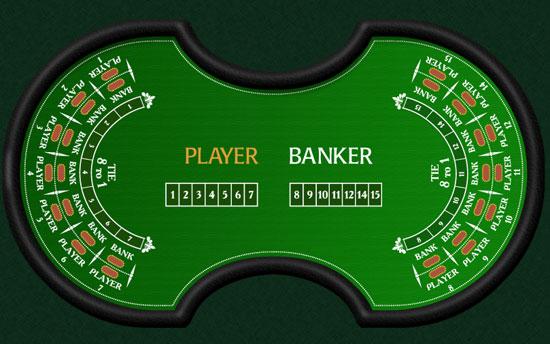
In Las Vegas and similar places, Baccarat tables will often be situated in a roped off area or behind closed curtains. This is intended to create an exclusive feel and to entice high rollers seeking privacy. It seats 14 people, with the dealer typically seated beside seat #1. Two other dealers are on hand as well to manage stakes, pay out winnings, and keep track of the House’s 5% commission on winning Banker bets. This 5% juice is due when the individual leaves the table, allowing for smoother game flow and fewer interruptions. Anyone choosing to act as Banker is not financially responsible for the Bank, merely acting in a role and can back Player hands if desired.
While many Baccarat enthusiasts believe staking the Player is best, this is a fallacy. Mathematically, it’s staking the Banker in spite of the 5% House commission. To assist with visualizing action, refer to the illustration on the right, although always remember that this is a game of chance, not skill.
Strategy Tip #1
Contrary to popular belief, staking the Banker has the best mathematical chance of winning, with odds of 45.84%, in spite of having to pay a house commission of 5% on all successful Banker wagers.
Strategy Tip #2
If offered the option to stake a tie, avoid it since it’s the worst mathematical option at the Baccarat table. The House has a 14% edge on all ties when offering 1-8 payout odds. In certain cases, establishments will offer 1-9 odds, which are slightly improved but still a sucker bet and therefore not recommended.
Strategy Tip #3
There is no such thing as a guaranteed winning Baccarat betting system. Save your time and money as these always fail in the long run.
Strategy Tip #4
Remember when playing in person that the House’s 5% commission is due when you leave the table. Ensure to have extra chips to cover the 5% before backing the Banker.
Baccarat Terms to Know
Baccarat: Means “Zero” in Italian. This is ironically the worst hand that you can get in the game.
Baccarat en Banque: A variation of the game.
Banker Bet: Staking the Banker’s hand to defeat the Player’s hand.
Banko: A synonym for “Bank”. At certain private tables, someone who declares ‘Banko’ indicates they wish to challenge the Bank’s full chip count.
Bankroll: Your full supply of money at the table.
Chemin-De-Fer: French for “railroad”, another variation.
Cheval: Some private tables have a rule stating the Player can have two live hands, which both must be won. If they win one hand and lose the other, it’s a tie.
Commission: This is an additional amount (5%) paid to the House on all winning Banker bets (in person only, not online).
Coupe: One single round of action.
Dealer: The employee who deals the cards and manages the action.
Le Grande: French for “the big one”. Refers to a hand value of 9.
Muck: This is used to describe the full 8 decks of cards used.
Natural: When either the Player’s or Banker’s first two cards have a total value of 8 or 9.
Petite: French for “small”. This refers to a hand value of 8.
Player Bet: Staking the Player’s hand to defeat the Banker’s hand.
Punto Banko: Another name for the game.
Shoe: Device where the cards are dealt from.
Shooter: Another term used to describe the dealer.
Standoff: When the value of the Dealer’s and Player’s hands are identical. Also referred to as a “tie”.
Super Pan Nine: Another variation.
Tie Bet: Wagering on the Player’s and Banker’s hands to be identical.